Showing posts with label Meeting People. Show all posts

20 June 2012

The Year in Review, Part 1: The People

Part 1 in a 3-part retrospective of the year I've spent in Bulgaria.

I'm not entirely sure that this post should be the first in this retrospective series. What I've come to realize is that an outsized part of the way I feel about a given place has to do with the people I meet there - people make experiences; experiences make feelings. I've also come to discover that I'm really more interested in people than most other things in the world. So I sort of feel like this should be the last, culminating chapter in this miniseries - but maybe it's just as well. I've already started; let's talk about the people I've met this year.

When I arrived in Bansko in August, I knew nobody. I was, as you'll recall, brimming with trepidation at the idea of being thrown into a new situation--social, cultural, and geographical--with no contacts and little command of the local language. My experience, having yet to have begun at that point, could have gone in literally any metaphorical direction. I was in for some kind of year, but the scary part was having no guarantee of what kind of year it would be.

FISI proved to be a godsend for how I would make my initial contact with the people of Bulgaria. It worked as those who organized it had conspired: Our first interactions with Bulgarians were with ones that had much in common with us, so the initial bonds developed easily. I made many friends those two weeks, not just with Bulgarians, but with Serbians, Croatians, and many others. Having that early nexus of contact was comforting, and it would prove invaluable to have a rudimentary support system already in place by the time I and my compatriots were finally released into the wilds of this country. More rewardingly, that support system grew into a web of friends, with some of whom I've kept in contact through the entire year. This place has been a lot less scary with them around.

One of the biggest lessons I have learned living in Sofia this year, not coincidentally corresponding to one of the primary aims of the Fulbright Program, has been that of openmindedness, and, more specifically, cultural relativity. The general idea was that, being acculturated to a certain society with its own norms and values, it would take an open mind to accept a different society with different norms than my own and to realize that, no matter how different the behavior of the people in that society might be, it would be as correct in that society as mine had been in my own. As simple and intuitive as that sounds, that consciousness has not always been easy to maintain this year.

Sofians, by habit--that is, by acculturation--do a lot of things that Americans might perceive as rude. Some things that we take for granted in our society, both small--smiling, saying "please," holding the door for people, giving the right of way--and larger--avoiding incursions into personal space, waiting in lines, and even refraining from low levels of public shaming--are not generally facets of the culture here. This is changing somewhat, especially--being subject to the highest degree of exposure to Western European culture in this country--in Sofia, but I have witnessed the breaking of all of the above American morés here. What has been surprisingly difficult to keep in mind is that these actions, performed by Bulgarians in their own society, have violated no social principles.

That's not to say that I haven't witnessed, and even been party to, genuine mistreatment in some instances. Jerks exist in every society, and Bulgaria is no exception. But the concept of cultural relativity is that values and norms in a society are, by definition, right within the context of that society if the social order accepts them, and if they persist, then it means that the social order has indeed accepted them. Every culture's customs, in other words, work in maintaining a functioning society. Even if some of the actions I've witnessed here violate the values of American society, those rules do not simply apply here, just because I'm an American. A society should not be expected to change for my sake. There is no set of universal human norms, save, perhaps, one or two, and so it is unfair when anyone thinks less of another culture because of theirs. Thence has derived my lesson in openmindedness.

I found, this year, that the degree to which I was able to integrate into this society was largely dependent upon my command of its language. Language being people's primary method of communication, this is not surprising. For most of the year I struggled to gain a better understanding of the language so that I could do things like have conversations, and progress was slow, but tangible. By this point, I can go out into the world and not be completely at a loss, which I'll claim as a moral victory. A lot of people speak English in this city, typically depending on their age, and they generally appreciate it if you make a good-faith effort to communicate with them in their language.

The generational divide doesn't just pertain to language use. The fact that many younger Bulgarians speak English while many older Bulgarians speak Russian is but one vestige of this country's fascinating recent past. This divide even extends, I've found, to manner, customs, and outlook. Younger Bulgarians tend to be more receptive to Western culture, and, less predictably, even tend to be more optimistic. If I knew more about the dynamics of this society and the psyches of its people, I could speculate that this has had to do with growing up in a "free" society as opposed to a "censored" one, one that is integrated into Europe and the rest of the world like it hasn't been in generations, one whose inhabitants have greater opportunities for mobility and wealth and individualism than their parents before them, but, sadly, I don't feel that I know these things well enough to make any sort of confident statement about them. What I've observed, to a large extent, is that younger Bulgarians tend to be more trusting and less skeptical than their older counterparts.

One of the things of which I've become acutely aware this year, something which I hadn't really thought about in any depth prior to my arrival here, is the fact that Bulgaria, despite its former membership in the Eastern Bloc, despite its location down in one of the more isolated corners of the continent, despite its proximity to the Middle East and, though less so, to Africa, is still a European country, and its inhabitants are still European people. As such, there are elements of its society that I've perceived to be pan-European. As it has turned out, I like Europe. I like the people's propensity for sitting in the park, drinking beer when the weather is nice. I like how dinner can take hours and hours, the meal and subsequent socialization being a process rather than an event. I like the fact that public transportation exists here, and the quasi-comical culture that accompanies it.

And I love the sociability of the Bulgarian people. This sociability was one of the first things I noticed about their culture when I arrived, in the midst of a heat wave, in the late Sofian August. At a time when the inclination of the average American would be to stay inside and turn on the air conditioning, Sofians refused to be deterred--many of them being without air conditioning in the first place--and came out in force to distract themselves from the heat. This was not just a warm-weather phenomenon, either, though the people of this fine city have come out in greater numbers over the course of the last few beautiful weeks than I have ever seen. Throughout the winter, round about 5 o'clock, the cafés, bars, and restaurants began to fill in identical manners to the ways they have filled on these recent warm summer evenings, only in the winter months, the drinks were hot and the doors were closed, the tables and chairs safely ensconced inside their establishments.

Just down the block from my apartment is a small park, and at the same time that Sofia's plethora of establishments (the sheer number of places to stop in and get a drink or something to eat being something I really love about this city, though we'll get to that in the next post) are getting full, this park--and, as I've discovered, seemingly every public space in the city--is overrun with families, children, adolescents, and adults alike. Babies are especially popular sights, much moreso than in the States, the significance of which I don't know enough about to speculate on. Though this results in a setting that is a bit too loud to be idyllic, it is nevertheless pleasant, and insightful, to boot.

This is representative of something that I always imagined when I pictured my ideal community: a group of people who spend their lives outside their homes, savoring the weather when it's nice, distracting themselves from it when it isn't. This was always my conception of the American dream - a vision of a community that lived its collective life not in isolation, but in the presence of the rest of its collective self. And, at least in this way, the Bulgarian people have not only fulfilled my idealization of community, they have, in some way, redefined it. When the day comes for me to find some place to settle down, to pick a group of strangers amongst whom to live in a place that may or may not be totally alien to me, this is the standard to which I will hold each prospective home. The people of Sofia have shown me that community like this can exist, and it is something I will forever hold a significant desire to be a part of.

It seems almost bizarre, but I have witnessed the realization of many small American dreams in this land so far removed--geographically, historically, politically, culturally--from America: unspeakably perfect, warm summer evenings, what seems like the entire population of the city out to enjoy the weather in all its splendor, ice cream vendors on every corner, adorable children happily frolicking in the glory of air that seems tinged with magic, dogs happily chasing each other, parents attending to their newborns, adolescents in the throes of tweenhood bravely forging ahead in their quest to find their place in this world, a sun that seems like it will refuse to set tonight, a world at contented peace. In its own not-entirely-superficial way, the dream of the white picket fence is thriving tonight, and I am fortunate to be, in this moment, surrounded by it.

If this has resulted in an overly romanticized or idealized account of the residents of this place, then so be it. The evening is beautiful beyond compare, and I am in a peaceful and generous mood I have rarely experienced so overflowingly. I am sitting in the Borisova Gradina with the first golden raisins I have tasted in a year, I have given my spare change to beggar and busker alike, the children are flying kites, smiles ablaze on their faces, so far from quarreling that their attendant father must certainly be as contented--for the moment, at least--as I am. It is difficult to be objective about this place or its people when surrounded by so much pleasantness.

I have had a true myriad of experiences with the people of Bulgaria this year, but overall, that body of experience has been decidedly positive. Fulbright is supposed to serve the purpose of cultural integration, understanding, and experience, and I certainly feel like I've accomplished that. I've had a good time here, and it is mostly attributable to the people who have populated my life in the past year. I will leave this place with positive memories of this society, maybe even having learned a few things. In that respect, my purpose here has been fulfilled.

03 June 2012

Welcome to June

It's fairly incredible and unbelievable that it is already the third of June. June has always been a month that has taken me by surprise, as it usually comes on the heels--or in the midst--of some manic attempt to complete something or somethings. It is the end of the school year, the choral season, the spring. This year, it is the end of my stay in Bulgaria.

As a result of all of these, I'm usually exhausted by the time this month rolls around, and it, despite my lack of foresight in anticipation thereof, that is always welcome, as it means the summer--which typically equates to a glorious period of rest and fun--is right around the corner. Which is now the case.

I have one more week, plus a couple of fudge days during the next, to finish drafting my thesis. A good thing, too, because I'm seriously starting to question my ability to write anything more at all. I have never applied myself to an academic venture of this magnitude before, and I'm worn out. This process has imbued me with the perspective to be flabbergasted by the reality that there are thousands of people out there who do this every spring, working under stricter deadlines than I, with more in their schedules.

Sporadically Diligently working on this demonic leviathan, however, has left me few opportunities to have fun. My attention span being shorter than is probably conducive to a 24-year-old male in need of some efficient work periods producing a paper of this magnitude in a timely fashion, my work days tend to get spaced out over a period of 12 hours or more, not entirely all of which is actually spent on work. This phenomenon tends to get in the way of having free chunks of time for getting out and doing fun stuff.

The good thing is, though, that today I got such a day, as I decided to leave my work for tonight--it remains to be done--and to just get out and relax. This morning I met Irena, committed the heinously indulgent crime of buying ice cream at 10:30 AM, busked out on Vitosha Blvd. for about an hour, went to a cafe, tried in vain to organize my notes so I could begin writing section 9, actually organized my notes, began section 9, and then chilled out with fellow Sofian Fulbrighter Sophia and her friend Adrienne for a couple hours to commemorate the 45 minutes of real work I had done earlier in the day.

And a good day it was for it, too, as this is the first day it hasn't rained (though four hours remain, I suppose, in which precipitation that would force me to eat my words could ensue) in, no lie, more than a month. I wore shorts today, and sat in the sun for awhile. It was really--really!--nice.

But as a result of this relative loafing, I'm left with many pages to write tonight, so I will bid you adieu and goodbye. Until next week, when, hopefully, I will be bursting with the news that my first draft is complete. Here's to hope.

10 April 2012

Thessaloniki, Passover, Lazaruvden, Tsvetnitsa

I apologize for the fact that this is two days late in coming (my endeavor being to publish over weekends), but in my defense, it was kind of an eventful week, and my normal three-day window for starting, developing, and finishing these well-copy-edited, insightful articles was pushed back. But instead of rambling on with another tired excuse, let's just cut right to the chase.

Chapter 1: Thessaloniki

One recent seminar already under my belt (read about it here), the Fulbright Commissions That Be saw fit to send me off to another one, balancing my trip up to the frozen wastelands of Northern Europe with one to Greece, the quintessence of Mediterranean life.

Leaving my packing, in typical fashion, for the morning of our departure, I hastily threw together the necessary items, caught a cab to Jamie's apartment, and he, Fred, and I set off on our 5 hour, 20 minute road trip to Thessaloniki. In spite of a couple of (very) wrong turns, we made it mostly without incident, and were welcomed that night with a reception in the art studio of the Thessalonian artist Soros. Much like Berlin's, this welcoming event served as our first contact with the other Fulbrighters in attendance, though instead of being charged with the Herculean task of meeting 500-odd people, we had simply to meet 30 or so, this conference comprising only that miniscule amount of wide-eyed wanderers.

The next day, with a good night's sleep under my belt (beginning to sound familiar?), I--much more happily than on the previous day--partook in the Seminar's festivities. These included presentations from 8 of the other Fulbrighters, which were both engaging and gave me some ideas about my own work, the author of a forthcoming book on Thessaloniki sharing excerpts therefrom, lunch in the swanky dining room of the hotel, and an after-dinner trip down to the White Tower, where I and my companions made merry--in the medieval sense--and furthered ourselves in the cause of meeting everyone else.

The next day's activities began at the Museum of Byzantine Culture, and the morning progressed in much the same fashion as the the previous day, comprising project presentations and the offering of another speaker--this time Athens' Deputy Mayor for Finance--who spoke to us about the current debt crisis. After a tour of the museum and a small lunch, we got to go on a bus tour of Thessaloniki, which contained some extraordinarily cool things. But instead of tell you about everything we saw, be it that the thing I leave you with from this fly-by of history is that I saw my first blooming tree of the Spring, so--poof!--there went my martenitsa.

Tying it to the branch
This would be the natural place to share any and all of the gorgeous pictures I took, but I, in my sometimes-staggering boneheadedness, neglected to bring my camera along for this tour, thereby relegating the spectacular views I witnessed to virtually certain forgottenness. Later, though, I would atone--at least with my own self--by venturing out, along with some new friends, on an ultimately-rewarding quest for gyros, which I found to contain, to my immensely pleasurable surprise, thick, American-style fries, which, when complimented with thick, American-style ketchup, transported me, in my mind, back to many a happy day under the Los Angeles sun.

As Wednesday dawned, we had come to our Last Day. After gorging myself on another large breakfast (I have really come to appreciate hotel breakfast buffets in the last 3 weeks, both German and Greek), I and the rest of my compatriots boarded a bus to visit the dubious purported tomb of Philip II of Macedon, father of Alexander the Great. Before we did that, however--and after one wrong turn dropped us right into the middle of a convent--we ended up at a little monastery nestled in the Greek mountains, which we toured, to the accompanying explanations of the abbot, Father Panteleimon. Check it out:

The view from the monastery. Seriously.
Inside
Leaving the monastery behind to a now-steady drizzle, we continued our journey to the Vergina Tumulus, whose curators insist contain the tomb of Philip II, though thorough scholarship makes a strong case against this possibility. Nonetheless, there is some very cool stuff housed therein, including, but not limited to, several relatively-intact tombs from the 4th and 3rd centuries BCE, which made for an interesting, if a tad too-long, excursion.

It was nearly 3 by the time lunch rolled around, and we were all exhausted, resulting in the collective lucidity and order of said meal being reduced by half, give or take. Returning to the hotel, and eschewing the proposed walking tour--which would have had to take place in the rain--we instead rested up before our final communal dinner. Some food and several bottles of wine later, we were transformed into a band ready to head out for one final night in Greece, which many of us did, and deep into the night, at that. While less of a raging affair than was our final night in Berlin, it was still fun, and to be sure, the next morning arrived far too early.

After breakfast, Jamie and I--Fred having departed late on Tuesday night--loaded up the car, and headed back the way we had come. Or so we thought. Making a wrong turn outside Thessaloniki, we ended up traveling more than halfway to Kavala before we realized that we were headed in the wrong direction. But, as with many wrong turns in this serendipitous universe of ours, it turned out to be a blessing in disguise.

After stopping at a roadside service station to get a map and figure out where the hell we were, we decided that the best course of action was to continue in the direction we had been headed so that we could pick up the highway that would lead us back to the E79, the freeway that would take us back to Sofia. And, as we made our way down the highway, passing from small town to small town, the Greek countryside opened up as I had always envisioned, but never got to witness; rolling hills and vineyards splayed before us like something out of a made-for-TV-movie on BBC. After 4 days in Greece, we were finally seeing what we--or, at least, I--had come with the expectation to see.


Stretching into the distance

Mountains
And this was only the beginning. Crossing the border back into Bulgaria, those fields and vineyards turned into the types of mountains I never expected to see in this part of the world, so much like the beautiful, rocky, sparsely vegetated hills I had grown to love in Southern California they were. The air was warm; the colors stark. Spring had reared its gorgeous head once again.

At the border

Seriously, Topanga?

The Pirins
Finally arriving at my apartment many hours after we had departed (with a good in-car nap to my benefit), I was feeling better, and ready to take on the next challenge: preparing a Passover seder in 24 hours.

Chapter 2:  Passover

Mere minutes after returning to my house, I threw open the windows (this day offering sun, warm air, and a light breeze), put on some music, and began to clean. Winter dies hard in this stalwart of the former Eastern Bloc, and 6 months of having the windows shut against the snow and wind will allow quite a bit of dust to accumulate. The time for Spring Cleaning had come.

So I vacuumed the floors and washed the walls, cleaned the bathroom and mopped the kitchen, moved furniture around, and put my winter blanket away. The sheer exuberance of a warm April day notwithstanding, I also had company coming in short order.

Every year, my family gets together on the first (convenient) night of Passover for a seder, something I haven't been able to be a part of since 2006. This year, being abroad, I wanted to try my hand at hosting one, hence all the cleaning. The cleaning ended up being just the beginning, though.

After doing an initial round on Thursday night (while listening to the first game of the Phillies' 2012 season on the radio, a textbook 1-0 victory), I woke up early-ish the next day to finish what I had started. Emerging from my now-pristine apartment around 1 PM on Friday, I headed out to buy the assortment of vegetables, fruits, wines, and matzah that would constitute the ingredients for my share of the Passover cooking. Arriving back at my apartment, I spent the next couple hours whipping up matzah-ball soup, potato kugel, xaroset, and the various other accoutrements of the seder plate.

And people came, and food, and wine, and pretty soon, 11 of us were seated around the periphery of my kitchen/dining room, reading from the Haggadah and singing the songs, making one of probably four seders in the whole country. It was an immensely nice experience, especially being so far from my family this year, and successful to a detail. Exhausting, but totally rewarding and gratifying.

Chapter 3: Lazaruvden/Tsvetnitsa, or, The Bus that Wouldn't Come

Lacking the opportunity to sleep in this past weekend, I arose on Saturday to go out into the field for my research for the first time since I narrowed my focus specifically to Shopski dvuglas. And though, in most places in the world, it should have been relatively straightforward to get to where I was going, it was anything but.

After calling up Alex, an American law student living in Sofia this semester, to accompany me--with getting lost a near certainty--we made our way down to Петте Кьошета (The 5 Corners) to catch the #17 мартрушка, the mini-bus that, I was told, runs to Gorni Bogrov, the village I needed to get to. Pulling up in my own bus just in time to meet her and clamber aboard the martrushka, I paid for our tickets and asked the driver to tell me when we had gotten to Gorni Bogrov. He replied that his route didn't include a stop in Gorni Bogrov. Thinking I had misheard him, I asked again, and annoyed, he replied that we needed bus 118.

Hopping off at the nearest convenient point, we then proceeded to mosey our way down a street that looked as though it ran in the right direction. After being supplied with fresh information in the shadow of the crumbling apartment blocks by another local, we hopped a passing bus and took it the four stops to where she had said to go. As this was the end of the line, we again hopped off and found ourselves in the middle of nowhere.

Trudging to the main road, we happened upon yet another bus stop and asked an overly friendly teenaged girl how to get to where we were going. She told us to head back to the stop where we had gotten off and take bus 14. This we did, when it finally came around, but to our chagrin, the end of its own line was a mere 2 stops hence. This stop, at least, was populated, and fortuitously replete with a scheme of Sofia's public transportation. It appeared to us as though we could get to the stop where we could finally board bus 118 via one final connecting bus, so before we boarded that, we bought day passes for ourselves, unsure of how many more trials we would have to go through before we reached our day's land of milk and honey.

Hopping on the appropriate bus for 2 more stops, it dumped us off at a remote terminal past which we could make out the tracks of a tram line. Upon further inspection, we discovered that it was tram 22, which happens to run directly in front of my apartment. 5 stops away. We had made a large circle.

Refusing to despair, however, we trekked up the road to a bus stop that looked like it could have been the right one. Instead of the promised 118 line, however, it showed only that bus 90 ran there. I was on the verge of giving up, when, perusing the list of stops along the line, I caught sight of the most blessed words I had ever seen in my life. Село Горни Богров - Village Gorni Bogrov. We had found our bus.

From there, it was simply a matter of waiting for it to show up, passing the time en route chatting with a rather nice fellow whose rudimentary command English was the result of many hours spent playing Starcraft with "millions of Americans," and getting off at the appropriate stop. Once we did that, though, the day became eye-opening.

I had come to think of the concept of the small Bulgarian village, tucked away in a remote corner of the landscape, as extinct, or, at least, so far removed from the bustling metropolis of Sofia as to be effectively out of reach to me. But ah!--such is the wonder and mystery of living overseas--how one is constantly surprised by any new culture amongst which one lives. 

One of the extraordinarily refreshing things I have recently discovered about Bulgaria is that there are no suburbs here, in stark contrast to the urban sprawl that has become the common plague of the American city. The city here literally fades away to countryside in a matter of meters. So there we were, less than 20 kilometers from the city center, surrounded on all sides by fields and small, ramshackle houses.

And it was beautiful. Before sharing the pictures I took, let me just note that the thing that really got me about this village was the juxtaposition of ancient and modern here. For starters, consider that we were standing, in the year 2012, in the midst of a tiny village that had probably been there for hundreds of years, with a European capital a few kilometers away. And within the city itself, the combinations of old and new were striking. To be sure, we found no mud-brick huts, but we found more than our fair share of old houses, and standing neatly next to them was a row of--there is no other word for them--mansions that would have fit in perfectly along the back streets of West LA. Most houses here, instead of a lawn, had a garden, neatly plowed, some with sprouts emerging from their soil, and I imagined that this was their modern-day adaptation of the subsistence farming paradigm that has been the hallmark of agrarian Western Bulgarian society for centuries.

Let me waste no more words on the subject:

Gardens

Note the secure fencing on the left and the tumbledown houses on the right

Alex and I just wandered around the village for a while, taking it all in. After a few minutes, though, we remembered the purpose of our, or, at least, my journey: to capture the performance of the Lazarus Day customs. And if the first half of our day had been marked by wrong turns, bad luck, and getting progressively more lost, the Great Forces of Equalization decided to make up for it during the afternoon hours, as we rounded a corner and stumbled onto the village's singing troupe.

We followed them for about half an hour as they went house to house, singing songs specific to the day and collecting food, hard-boiled eggs (traditional for this holiday), and money. When it was time for us to part, they cheerfully replied that I could take their picture.

The keepers of the tradition
Not quite having gotten my fill of the rural landscape, though, I wanted a few more pictures before we departed.

Mt. Vitosha across the plain

The old section of town

A shepherd with his flock

It ended up being a very interesting day.

The next day served much the same purpose, but with far fewer complications and far less drama. Heading out to the village of Jelyava--in the same direction as Gorni Bogrov, but further out--I went, alone this time, to attend the celebrations put together by the chitalishte, the community center, for Tsvetnitsa, or Palm Sunday.

After my trip on what must have been the oldest and slowest bus in existence, I finally arrived, 30 minutes late, to the village, and proceeded up the winding road to the chitalishte. When I got there, I found, instead of folklore, a junior cheerleading squad doing a dance routine to a techno remix of the Popcorn Song. Though initially a bit confused, my patience was ultimately rewarded by 10 minutes of authentic dvuglas from a sextet of babi, though to my annoyance, the crowd apparently did not find it engaging enough to give them their attention, talking loudly over their performance.

Thus went these particular praznitsi - vestiges of tradition mixed with the modern. It seemed to be a microcosm for how Bulgarian society has appropriated tradition today--by diluting it, with an amount, that I have yet to ascertain, of disregard for it, with the modern--but this will be the subject of its own post at some point in the future, as it is a crucial and interesting point of this culture, so I won't get into it now.

After making my way around the inexplicably cold village (believe me when I say that winter dies hard here) to take some more pictures, the bus mercifully came around again, and I went home.

It was quite a jam-packed week, and it contained a lot of new things for me to assimilate. I'm still working through them, but ultimately, I think it will prove to be one of those weeks that help to crystallize my experience here. So there's a good chance I may be revisiting it in the coming months.

That's about all for me this week, and with good reason, as I'm catching a flight to Vienna in a few hours to visit Austrian Fulbrighter and friend from home Andrea. From there I will hop to Munich for a couple of days before returning to the friendly confines of my adopted home. So until the weekend, stay happy, stay healthy.

25 March 2012

Breakfast in Berlin

Things I have done in the last three days in defiance of the fact that it's still March:
  • Hung my laundry on my outdoors clothesline
  • Wore my flip-flops when I went out
  • Went for my first outdoor run of the year
  • Busked in the metro station for money (and made 12 лева!)
  • Smiled at everyone and everything, because it was 21° (70°F) (!)
It's Springtime in Bulgaria. The calendar says it, the martenitsi say it, and, best of all, the weather says it. Color me exuberant.

I should preemptively apologize, at this point, for my near-certain preoccupation with the weather over the course of the next several weeks. As I mentioned before, I hate the cold, so the couple of weeks in March when it starts to get warm again and everything comes alive is one of my favorite times of year. I can get a little obsessed. So please excuse all future references to the weather from here on out.

Let's talk about my awesome trip to Berlin, though, ja?

This past Sunday to Thursday was the annual conference in Berlin of a selected sample of European Fulbrighters. For four days, this miniscule club of 600 was tasked with sitting through rather a lot of presentations and making the effort to meet every single other member of said club. In retrospect, I think we did surprisingly well.

Very early on Sunday morning, Fred and I caught a flight to Berlin by way of Munich. Arriving at Berlin's Tegel Airport around 10:20, we caught a bus that conveniently delivered us directly to Alexanderplatz, where our hotel was located. As we checked in, I found Laura--who had ventured up from Munich the previous day--waiting for me in the lobby, and we crashed for a couple of hours (as I, having awoken at 4:45 AM, was experiencing something akin to the sleep deprivation that might befall a survivor of the Apocalypse) before setting off, with several hundred of the other Fulbrighters, on a tour of the city.

Designed to be a survey tour rather than a detailed one, the bus took us to a lot of the sites important to the history of Berlin's role in the Cold War, and, of course, showed us much of the path where the Berlin Wall stood. Starting at Alexanderplatz, we soon found ourselves at the East Side Gallery, a section of the Wall that has been painted over extensively by muralists and graffiti artists alike.

The East Side Gallery
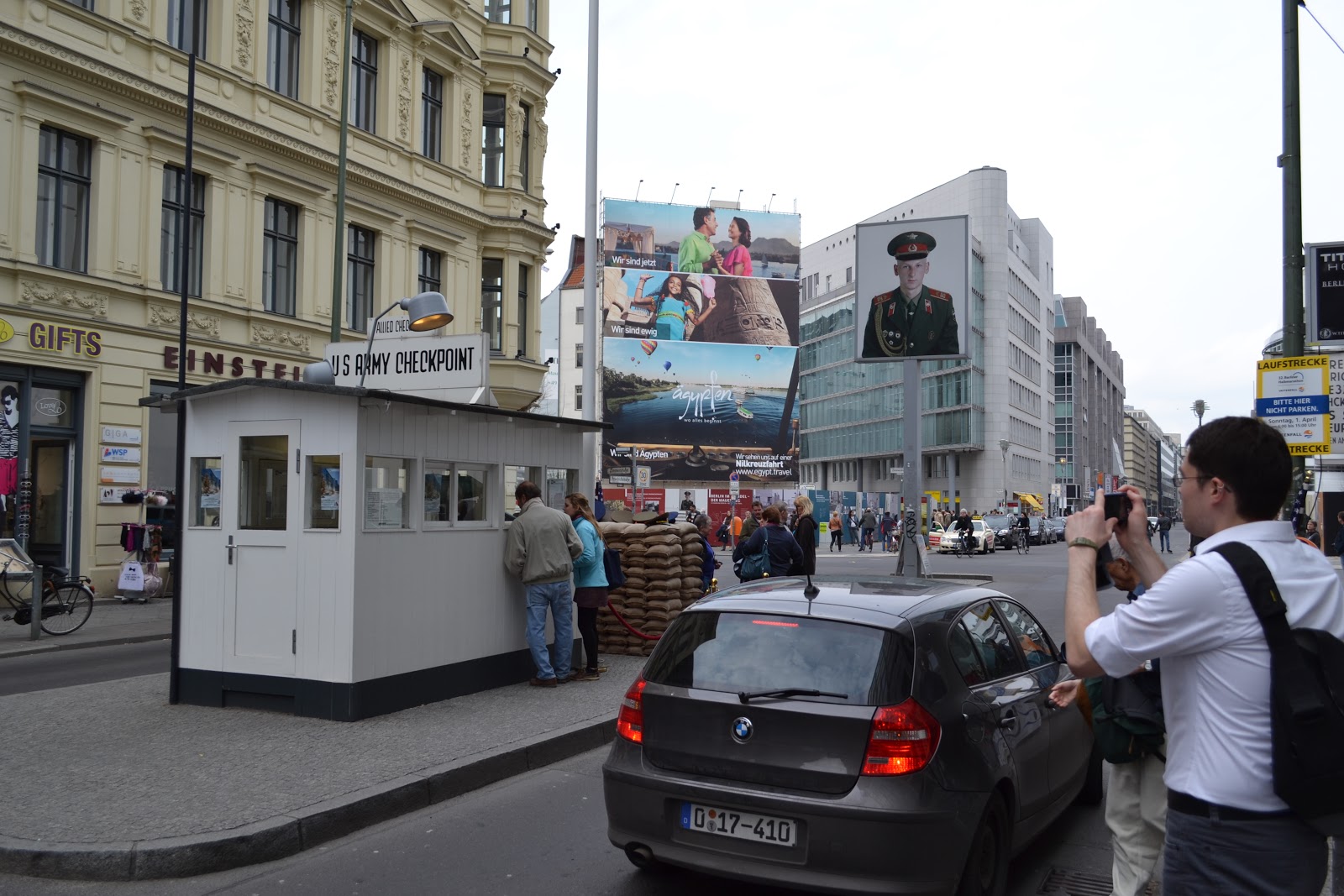
Driving past this section of the Wall for a while, we then crossed the Oberbaumbrücke into West Berlin. Driving through some of the more "artistic" neighborhoods on this side of the city, we ended up at Checkpoint Charlie, which was not, I was surprised to learn, a metaphorical character symbolic of the division between East and West, but rather an actual border crossing at the former site of the Wall.

Anonymous Soviet Soldier is watching you
After a fascinating trip through the museum that accompanies this landmark, we headed off again through Potsdamerplatz, past what I believe was the seat of the European Trade Commission and the former headquarters of Radio In the American Sector, and found ourselves at another section of the Wall that has survived, largely unaltered, since it was constructed.

Here stood the Wall

The Iron Curtain epitomized
Following this, we began to make our way back toward the hotel, along the way passing several musea, Humboldt Universität, the Berliner Staatsoper, and the Berliner Dom (pictures of that to come later) before finding ourselves back at Alexanderplatz. Our tour ended, we filtered back up into the hotel.

Resting up a bit more before dinner, I met my roommate for the week, Arthur, and we went back downstairs for the pre-meal ceremonies. Dinner itself was a raucous (and delicious) affair, with the introduction of good beer and wine almost certainly a move motivated by the desire to facilitate networking. Well, it worked. Three hours later, having met a large share of the students flung afield throughout Europe, I left the dining room to meet Laura before she had to catch a midnight ride back to Munich.

Having somehow survived this long day, I fell into bed that night and awoke the next morning with a good night's sleep under my belt, and feeling all the better for it. Monday would set the tone for the rest of the conference, as it featured several long "mini-conferences" (speeches, panels, and the like), several more "networking meals," and on Monday night, a long opening ceremony at the Federal Foreign Office featuring several speeches auf Deutsch (perhaps defeating their purpose for the non-Germanophone members of the audience), after which there was a reception filled with supremely delicious German delicacies. Said reception also featured my reconnection with a couple of old classmates at USC, neither of whom I knew were in Europe on Fulbrights. It was a Small World Moment.

Tuesday, though filled with different content, contained many similar events. The morning session featured another spate of speeches at the Berliner Rathaus (City Hall) and a Q&A session with Björn Böhning, the head of Berlin's State Chancellery. (The Rathaus also contains a very imposing and very cool painting of the Congress of 1878--which I couldn't help staring at every few moments--at whose center is a towering and dour-looking Otto von Bismarck.) After lunch, I decided to make my way around our section of Berlin to see some of the cool stuff we hadn't had the chance to see on Sunday.

Within a few meters of the hotel are Berlin's TV tower and the Marienkirche. The TV tower is rather large.

Seriously.

Just down the road are the Rathaus and its awesome (and mildly famous, I've heard) fountain.

Poseidon with the Marienkirche in the background
Another few meters down from these magnificent wonders (there really is a lot of cool stuff in this neighborhood packed into not very much room) is a Platz bounded by the Berlin Cathedral and the Altes Museum, with the Humboldt Box just off to the side. None of the following pictures will really give you an accurate impression, but one of the reasons this area is so fixating is because these structures are gigantic with a capital HUGE. Seriously. They are beautiful, and old, and large.

Altes Museum
The Cathedral, with the TV Tower in the background
Tearing myself away from this concentrated display of Old World architecture after taking 98265898356 pictures thereof, I continued my journey along the River Spree, only stopping to witness an impromptu performance by a couple of Marktsackpfeife players accompanied by a drummer.

Super cool
My next stop was the Neue Synagoge, which was built in 1866, set on fire during Kristallnacht in 1938, and destroyed by bombing in 1943. It was rebuilt after the war, and dedicated in 1966 on its 100th anniversary.

Like few synagogues you've ever seen
After that, I headed back south to the Spree and continued to follow it west. After crossing over it on the Friedrichstrasse bridge, I headed toward the penultimate stop on my mini-tour: the Reichstag, the seat of the German parliament.

Approaching it from the river

BAM
After stopping to marvel--again--at how grotesquely large yet another important piece of architecture was in this city, I walked the last hundred meters to the final destination of my tour, the Brandenburg Gate, made famous, perhaps, by this photo:

Hopping the Wall in 1989
Here's what it looks like 22 years later:

With Victoria and her horses looking on
Having seen nearly everything I had set out to see, and running short on time before dinner, I made my way straight back to the hotel down Unter den Linden. After stuffing my face for the millionth time on this trip, it was time for the Music Gala, an extensive concert put on by some of the current Fulbright music students. Though I was expecting it to be good, it turned out to be really good, and it made me miss the days when I used to go to concerts all the time. (But those days are coming again soon!) After returning to the hotel, I went out to a local Brauhaus to grab a beer with several members of the Spanish contingent, plus some others, thus ending another long day.

And just like that, when I awoke the next morning, it was the last day of the conference. It was a good one, too; the morning featured the project presentations of 9 current Fulbrighters as well as a panel of 8 others who shared their experiences with such exotic locations as Finland, Hungary, and Sweden. After a lunch of some surprisingly good Chinese food (prepared by a Korean woman on the streets of Berlin - I love Europe), we had another panel regarding the future of the EU with several officials thereof. It was a great chance to learn about the dynamics currently working themselves out within the economies of Europe, ask some questions about them, and speculate about where everything was heading.

After dinner, we were all bussed to the Kulturbrauerei, a club/bar-like situation, where we hung out, danced, and got the last of our "networking" out before we had to depart. It made me realize how much fun I had had at the conference, and that it actually had its intended effect - I now know people living all over Europe, which will be awesome come this summer (more to come on that in a few months).

But alas, even after staying out until 2:something AM, breakfast the next day refused to postpone itself to a decent hour, so I dragged myself out of bed, forced myself downstairs, and had a long, groggy breakfast, mostly spent rehashing the details of the night before. After checking out, I went to lunch with Joe, one of my aforementioned USC compatriots, and then set off to see a couple more things before my 5 PM flight. The most important of these was the Memorial to the Murdered Jews of Europe, located just to the south of Brandenburg Gate.

The Field of Stelae

From inside
After spending an hour and change absorbing all of it, I was out of time, and caught a bus back to TXL. Fred and I got back to Sofia at 9:30, and just like that, our trip was over.

It was fun. I really like Berlin.

Now it's back to reality, and I have a mountain of work to do this week before it's off to another conference in Thessaloniki. Stay tuned for more.

14 March 2012

Here Comes Crunch Time


As I mentioned in my previous post, I'm down to my last 3 ½ months here, as unbelievable as that is. One of the many things that means is that the time I have left to finish my research and write my thesis is dwindling, and I still have a long trek ahead of me to finish up. 

Still to go on the reading front is my current book, in addition to 3 other long-ish articles, 2 of which are in Bulgarian. After that, I'll be camping out at BAN's audio and video archives, transcribing and analyzing the recordings of the folk songs they contain. Following that will be a fairly intensive week of fieldwork during Holy Week, as I'm hoping to watch celebrations on Лазарувден (Lazarus Saturday, the day before Palm Sunday in the Orthodox Churches), Palm Sunday, and Easter Sunday. Somewhere, in this whirlwind of academic interest, I will also be interviewing Kremena Stancheva, one of the prominent members of the Filip Kutev Ensemble, and then meeting with a few people who are helping me out with other, mainly ethnographic, niches of my research. 

Destination? May 4.

Things are going to be made slightly more difficult by my absences from the country. This Sunday, I'm heading to Berlin for five days, and then two weeks later, I'm going to Thessaloniki (which trip I am looking forward to with an extraordinary amount of anticipation) for another five days. The icing on the fluffy Travel Cake will be my trip back to the States on April 20th for my brother's wedding.

But: If I can somehow adhere to this condensed, somewhat manic schedule, I will be in great shape heading into the "writing leg" of my grant. I had in mind a budget of two months to churn out around a 50-page thesis, and this schedule will give me that. We'll see how well that goes.

I've had my doubts about how well it was going to go because for the last couple of weeks, to be honest with you, I think I've started to mentally check out. I'm going to the school of my dreams next year, and nothing else really seems to matter at this point. I've had a one helluva classic case of senioritis. But the realization that this veritable mountain of work, the very justification for my time here, remains to be done snapped me out of it. Today, at least. We'll see about tomorrow.

But despite my less-than-100%-applied approach the last week or so, I haven't been totally excreting my time away. Renewing my efforts to learn more of this idiosyncratic South Slavic language, I've begun working in my old textbook again, and on Saturday, I went to my first conversation swap. 

It was an interesting affair, multifarious and disorganized, but I managed to find my way to a table where I got some practice speaking Bulgarian (and, inadvertently, a little German) with some indulgent native speakers and a few fellow learners. It was good, much-needed practice.

All the time I've spent in the library deciphering dense, Communist-era texts has done wonders for my reading and comprehension. I got to the point, after I got going today, where I read an entire page on which I could identify most of the words and figure out their meanings by context and etymology; I typically only have to look up about 10% of the words in these texts now. 

This method of learning has presented two problems, however: The vocabulary I've assimilated, made up largely of terms specific to Bulgarian folk singing and ethnomusicology in general, is in a maddeningly academic, ennui-inspiring register, and therefore of little help to me in everyday conversation, and, of course, it hasn't improved my verbal skills at all. My ear, through repeated bombardment, has gotten marginally better, and if I think and speak slowly enough, I can eventually--to the patience-testing chagrin of my listener--articulate my thoughts back thereto. But what I really need, at this point, is regular conversation on a wider range of topics, so the conversation swap was a welcome test of my skills.

So the theme of the week and, I fear, for the rest of my time here, has been and will be forced productivity. We'll see how long I can keep that up. Til next time -

11 March 2012

In Which I Come Crawling Back from the Wars

Hello again.

Nothing I could possibly say herein would serve as ample justification for a month-and-a-half-long absence. But, if it please the court, I'll tell you my story and let history be my judge.

What seems like an eternity ago (the date actually being November 1st), I got back from a trip to Romania and began in earnest the process of applying to grad schools. I was nervous, but--perhaps in greater measure--tragically overworked in completing what would seem to be the simple tasks of filling out electronic applications, writing and editing résumés and personal statements, selecting and editing footage of myself conducting, and jumping through the hoops requisite to making it all official. These tasks, however, proved to be not-quite-so-simple, and I worked, with ever-increasing degrees of desperation, right up until my deadlines, most of which fell on December 1st.

Having accomplished these surprisingly Herculean tasks--in quintuplicate--I was pretty exhausted, but, having partially neglected my responsibilities to my country grant to get them done, I worked more or less feverishly over the course of the next two weeks to make up the lost ground and finish the calendar year strongly. Luckily, I did, and had a nice two-week break to recuperate, grad school applications having receded, more or less, from my consciousness.

Then, I returned to Bulgaria and Real Life caught up with me. I learned about auditions at Westminster Choir College and Yale in quick succession, and was treated to the first Sinking Feeling In My Stomach in a while when I realized that they were scheduled for the same day, February 27th. Working as best I could to resolve the conflict, I got Westminster to reschedule me to February 3rd, but by the time that particular flurry of correspondence resolved the situation, it was January 18th, leaving me two weeks to prepare two movements of Brahms' Requiem, coax my dormant knowledge of music theory and my aural skills out of their deep hibernation, learn to play piano, study up on said work, and book a flight back to the States. But all of these I did as I continued to put in my hours at the library.

Given this cornucopia of Things To Be Done, I didn't have time to breathe, let alone sleep. Those two weeks were among the most manic of my life, but, somehow, some way, I managed to cram an amount of productivity into them that would make the heads of the staunchest proponents of the Big Bang Theory spin. And just like that, without a single chance to pause and decide if what I was doing was just mostly or completely nuts, I was off on a plane back to the States.

One of the things I've been debating as I've been planning out this humblest of returns to you, my indulgent and forgiving readership, is how much to actually say about my time back in the States. This is a travel blog, after all, and it, as sure as Barbra Streisand is both a Grammy Award-winning music goddess and a #1 club hit, isn't named An American in America. That would be gratuitous and silly.

So forgive me, should you find it necessary to do so, for choosing the Middle Way of going about this: I'll leave you with just enough detail to give you an idea of how my month went, but, as I've already rehashed nearly every moment of every day of it, either to myself or to others, I'll avoid doing so here. If you're really dying for a blow-by-blow, appeal to me via some medium other than this one, and I promise, I'll oblige you.

So...I landed on a Wednesday night; 36 hours later, I was driving to my first audition. (Driving, in and of itself, was strange. It took the end of my six-month vacation from driving a car to realize how incredibly pleasant it has been not to have been concerned with the operation, maintenance, or--most of all--costs thereof.) The Westminster audition would turn out to be a semi-grueling, all-day affair, one which tested my level of preparation. But despite the short amount of time I had had to prepare for it, it went mostly well, and I came away feeling good about what I had done, all things considered.

If you thought I was in panic mode following my abrupt decision to fly home and audition two weeks hence, imagine my state of mind, five days after that particular decision, when I found out I had also secured an audition at the University of North Texas. The kicker in this scenario? This audition was scheduled for three days after the one at Westminster, though I managed to stretch that three to five after supplications to the head of their program. But the inadequate amount of time I had to prepare for my first audition forced me to put off preparing for the second until the first was finished. So when that day had come and gone, I switched gears to spend the next three days cramming every bit of knowledge and music into my head that I could.

For those of you who aren't conductors, two weeks--let alone three days--is a woefully inadequate amount of time to prepare the amount of music that these fine institutions required of their auditioners. Without going too much into the process, it takes a while to internalize said amount to the point where one can hear errors in its rendition, and as dedicated as I was in feverishly trying to do so, I came in feeling moderately underprepared for the first audition and horrifically underprepared for the second.

The day before my audition at UNT, I flew to Dallas, and I stayed with some friends of my mom, who, fortuitously, live quite close to its campus. When they dropped me off the morning of the audition, I had no idea what to expect. As it would turn out, the process there was much lower-impact than the one at Westminster had been: I sat in on a lesson, had a relatively brief interview, went out to lunch, sat in on choir rehearsal, and rehearsed the choir through my two quite-underprepared pieces. That was that, and, another audition down, I celebrated that night with my buddy Adam, whom I hadn't seen in more than a year.

I flew back to Philadelphia the next day, and the day after that, I began preparing for the big one - Yale.

Yale happened to be Choice Numero Uno on my list, and, fittingly, presented the most extensive and challenging audition. In addition to the usual litany of tests--theory and aural skills, sight-reading, and the like--we had to dictate a Bach chorale, identify unmarked scores, sight-read an open-score four-part Bach chorale in c-clefs, conduct a movement of Carmina Burana, and prepare six movements of Messiah. With two and a half weeks to prepare, I had my work cut out for me.

But Yale boasts by far the best reputation and the highest-quality education of the bunch, and, perhaps even more desirable, a guaranteed full scholarship to all music students, so it had been my primary target from Day One of this process. With great tribulation comes great reward, and boy, was I in for some tribulation.

I spent nearly every day of those two and a half weeks locked inside one practice room or another (as well as living rooms, dining rooms, kitchens, hotel rooms, libraries, and even, once, a car), feverishly preparing music, practicing my score reading, scribbling notes onto manuscript paper, reading up on the history of Messiah, settling on bowings and marking them into my score, and all the other hurried actions of an aspiring conductor with a less-than-adequate amount of time to prepare for the biggest audition of his life.

I can honestly say I have never worked on something so hard.

But all that disciplined work, borne out of a greater hunger--a greater desire to achieve--than any I had ever experienced, changed me, much in the same way that spending this year abroad has, and continues to, change me. Somewhere along the way, I was transformed--through the work itself--into something I have always desired to be - disciplined; a winner; the type of person you see on ESPN who, out of sheer will to win and drive to succeed, puts themself through all kinds of hell to get what they want.

I have never been that. I have never been the most disciplined or the hardest worker. But the last month, and especially those two and a half weeks leading up to the Yale audition, turned me, out of sheer necessity, into the hungry striver with the superhuman will to achieve. It was one of the first times in my life that I had wanted so badly to succeed that I made myself miserable in the pursuit. And as I put in the hours, day after day, and began to look back on the body of work to which I had applied myself, I began to feel more strong and capable and successful than I ever had before. I had finally begun proving to myself that I could be focused, and disciplined, and relentless in pursuit of something. I began to feel like I could do anything. It was intoxicating.

So I came to the audition prepared as best I could be, given the sub-preferable amount of time to be so. Things went about as well as could be expected (though made interesting by the spacing of my appointments between 8:30 AM, 4:15 PM, and 9:50 PM, leaving me lots of down time to psyche myself out), I had a great experience talking to the other auditioners and some of the current students, and when it was all over, a huge sense of relief washed over me that--finally!--my whirlwind 4-months-or-so were over.

And so, I returned to Pennsylvania with a huge weight lifted off my shoulder, simultaneously feeling empowered by the sense that comes from climbing a mountain you didn't think possible. And though I flew back to Bulgaria (and to Laura, who was waiting for me at the airport) the next day, a part of my mind lingered on the previous month, decompressing and sifting through everything I hadn't had the time to think about at the time it was happening. And a few days later, I learned that all that miserable, relentless work had paid off.

I got in.

I'm going to Yale in the Fall.

Since being back, I've taken a little time to celebrate, despite being preoccupied by the need to get back to my research. This week, I've been transitioning back into library work, which will soon give way to the next leg of my research - analyzing recorded material in the library's Archives. I'll go into more detail in my next post as the situation develops.

Overall, it has been an exhausting couple of months, but things are beginning to get back to normal here. My goal for my last four months in Bulgaria (can you believe it?) are simply to finish my research and get my thesis written. To accompany that, I'm delving back into my effort to learn this boondoggle of a language, I've gotten back to my workout routine, and here I am, reaching back out to all of you after my heretofore hibernation.

While we're on the subject of Spring Thaws, let me wish everyone a very belated честита Баба Марта (literally, Grandmother March, as this month, with its wild swings in weather and temperament, is personified by a cranky geriatric). The day I flew back, March 1, was the traditional beginning of Spring here in Bulgaria, and to celebrate Nature's rebirth, Bulgarians wear мартеници (martenitsi), little bracelets of red and white, of which I've received two from a couple of friends.

Ever onward; ever upward. My tale thus completed, let me bow respectfully from the room and leave you to contemplate all herein. But I'll see you very soon.